Student & Family Handbook
2027–2028 Training Year
A Note to Our Families
Welcome to Western Pennsylvania Youth Ballet.
For many families, this handbook will be their first introduction to our School. It explains our expectations clearly, but it can show only part of what WPYB is. It cannot capture the music, the small moments of discovery, the friendships taking shape, or the excitement that travels through a group when something finally comes together. Those things are every bit as much a part of WPYB as the policies described in the pages ahead.
Ballet is a serious art form, but children do not need a joyless environment in order to take their work seriously. In our classrooms, laughter and joy are part of learning. Students will work hard, make mistakes, try again, and discover that discipline can exist alongside warmth, playfulness, and a genuine sense of belonging. They will also experience the particular happiness that comes from accomplishing something together.
Clear expectations are also part of creating that environment. When children know what to expect—and know that the adults and students around them share those expectations—they gain something dependable. They can stop wondering where the boundaries are and begin concentrating on the work in front of them. Consistency gives students security; security allows them to take risks; and those risks gradually become confidence.
The standards described in this handbook are not meant to catch children doing something wrong. They give students a clear path and something meaningful to work toward. Expectations will always be taught in an age-appropriate way. No student is expected to enter already knowing the traditions of a ballet classroom, and no child will be expected to navigate them alone. Teaching those habits with patience, honesty, humor, and respect is part of our work.
At WPYB, we believe in changing lives through art. That does not mean every student must make ballet a career. It means that the qualities developed here—resilience, concentration, responsibility, work ethic, attention to detail, respect for others, and the ability to find joy while doing difficult things—remain useful wherever life leads. Whether ballet becomes a student’s profession or simply one important chapter, the education should travel with them.
The pages ahead explain how our School works. I hope this note helps explain why. We take this work seriously because we take our students seriously, and because we know how much they are capable of becoming.
Welcome to WPYB.
Michael Villella
Founder
Western Pennsylvania Youth Ballet
Section 1: Welcome & Educational Philosophy
Ballet asks students to work with precision, patience, musicality, and imagination. At Western Pennsylvania Youth Ballet, those qualities are developed deliberately—one class, one correction, and one carefully built skill at a time.
Our Approach to Training
WPYB provides methodical, progressive classical ballet training for young dancers. Each level develops the physical understanding, coordination, strength, musical awareness, and confidence needed for the work ahead. Students are not hurried through vocabulary or advanced for the sake of appearances; they are given time to understand and perform their work with increasing clarity.
Structure is central to classical ballet, but it is not the end of the education. As alignment, coordination, musicality, and movement patterns become secure, dancers gain greater freedom to move fully, respond to music, make artistic choices, and communicate through the body. Our teaching joins discipline with curiosity and technical precision with individual growth.
Progress is cumulative and personal. Students develop at different rates, and each new skill depends upon foundations established through earlier work. WPYB builds those foundations carefully so that students can progress with strength, clarity, and confidence.
Why This Handbook Exists
A productive ballet education depends upon a shared understanding among students, families, faculty, and the School. This handbook explains the practices that make safe, consistent, and focused training possible and provides families with a reliable point of reference.
These policies are not rules for their own sake. The uniform allows faculty to see alignment; attendance allows a progressive syllabus to work; punctuality protects physical preparation; studio etiquette preserves concentration; and production policies protect the full cast. Wherever possible, this handbook explains the purpose behind an expectation.
A Shared Responsibility
WPYB will teach with clarity, consistency, and respect while maintaining the standards of serious classical ballet training. The School will place and advance students according to readiness, communicate important information promptly, and provide an environment in which students can ask appropriate questions, receive correction, and develop confidence without humiliation. Each student’s progress will be treated as individual while the sequence and integrity of the curriculum are preserved.
Students support that work by arriving prepared, attending consistently, listening carefully, and participating fully. Families make the education possible by helping students meet those commitments, reading School communications, and raising questions directly and respectfully. Clear roles allow every student to work safely and confidently.
Section 2: Programs, Placement & Progression
WPYB’s curriculum is a progressive course of study rather than a collection of unrelated classes. Each level has defined technical, physical, musical, and artistic objectives, and the work introduced at one stage prepares students for the vocabulary and expectations that follow. Placement reflects what a student needs now—not simply age, school grade, prior level, or length of enrollment.
Full Program & Open Program
Pre-Primary and Primary have one enrollment path: all students enroll in the complete program offered for their division.
Beginning with Level 1A, the Full Program is WPYB’s recommended enrollment path. The Open Program is available by faculty approval when a reduced schedule is appropriate.
Full Program
The full program is WPYB’s recommended enrollment path and the foundation of the School’s progressive training. Full Program students enroll in at least the prescribed number of weekly classes and instructional hours for their assigned level. This requirement may be less than the total number of classes available. The current Full Program requirement for each level will be identified in the School’s schedule and registration materials.
Full Program students pay the comprehensive tuition established for their level. That tuition includes every available class offered at the student’s assigned level, as well as eligible supplemental lower-level training described in Section 3, subject to available space and School attendance procedures. Students are encouraged to take advantage of these additional training opportunities at no additional charge.
Attendance expectations, evaluation, and progression for Full Program students are based upon participation in their prescribed classes and instructional hours.
Open Program
The Open Program is available to students enrolling in fewer weekly instructional hours than the Full Program requirement. This may include students choosing a reduced WPYB schedule for any reason or students using WPYB to supplement training received elsewhere.
Participation requires faculty approval, appropriate placement, and available space. Open Program students enroll in specific recurring weekly classes. The Open Program is not an unscheduled or drop-in option.
Open Program tuition is calculated according to the total instructional hours in the student’s approved weekly schedule, using the published Open Program rate. That amount is converted to a monthly charge and processed on the first day of each month. Full Program pricing does not apply.
Open Program tuition includes only the specific classes for which the student is registered. It does not include additional classes at the student’s level or supplemental lower-level training. Except for an approved make-up under Section 3, attendance in another class requires prior School approval and an appropriate adjustment to the student’s enrollment and tuition.
The monthly charge reserves the student’s recurring schedule and is not recalculated according to individual attendance or the number of times a class meets within a particular month.
Regardless of enrollment path, every student who trains at WPYB is a WPYB student. Full Program and Open Program students receive the same standard of instruction and follow the same uniform, conduct, safety, communication, and classroom expectations. Because Open Program students receive fewer weekly instructional hours, progress may take longer, and students may remain in a level for additional years. Open Program enrollment does not guarantee advancement according to the Full Program timetable. A student who later wishes to enter the Full Program will be placed according to current readiness and the prescribed class load they are prepared to undertake.
Program Structure
Pre-Primary generally serves students ages three and four. The Primary Division—Primary A, B, and C—generally serves students ages five through seven. Age provides a general starting point, but placement and progression reflect each student’s readiness and instructional needs. Progression is not automatic by age, and a student may spend more than one training year in a Primary level when additional time will best prepare them for Level 1A. Primary A is offered as a distinct class. Primary B and C may be scheduled separately or together as Primary B/C according to enrollment and the instructional needs of the students. These early programs introduce coordination, musicality, classroom habits, ballet vocabulary, and a joyful relationship with movement while preparing students for the concentration and physical understanding required in the Leveled Division.
The Leveled Division generally begins with Level 1A at approximately age eight. From that point, placement is based upon the student’s present technical and developmental needs. Students of similar ages may therefore be placed in different levels, while students of different ages may appropriately train together.
Placement & Advancement
Faculty determine placement and advancement through ongoing observation of the whole student. Considerations include technical understanding, strength, coordination, musicality, concentration, attendance, maturity, retention of material, and the ability to apply corrections consistently. The goal is to place each student where they can work productively, confidently, and with appropriate challenge.
Students entering with previous training may be asked to take a placement class. Because schools organize levels differently, a former class title does not determine WPYB placement.
The Leveled Division is generally structured around one school year per level, and students who attend consistently and meet the objectives of their level should expect to progress the following September. Remaining in a level for an additional year is sometimes the most productive path; it provides time to secure coordination, strength, musicality, understanding, and confidence and does not signal failure or lack of potential.
Most level changes occur at the beginning of the September training year. When faculty believe a midyear advancement is appropriate, the School will first speak with the parent or legal guardian about the change, including any effect on schedule or tuition. A student will not be moved without that conversation.
Routine annual progression will appear in School schedules and registration information. WPYB will contact the family directly when recommending a midyear advancement, an additional year in the current level, or another placement outside the expected sequence. Families are welcome to request a private conversation about their own student’s progress.
Section 3: Attendance & Punctuality
Ballet training is cumulative. Each class builds upon work taught before it, and students depend upon repetition to develop strength, coordination, memory, and confidence. Regular attendance is therefore part of the education, not simply a scheduling preference.
Attendance also teaches responsibility. Enrollment represents a commitment to the student’s own work, classmates, and teachers. Learning to honor that commitment—even when motivation is lower or attendance feels inconvenient—develops perseverance and accountability that remain valuable beyond ballet.
The expectation is not perfect attendance at the expense of health or well-being. Illness, family responsibilities, and unavoidable circumstances arise; WPYB asks for consistent participation and honest communication when a student cannot attend.
Regular Attendance
Students are expected to attend the prescribed classes and instructional hours included in their approved enrollment schedule. Families should report an absence or anticipated late arrival through the Parent Portal or official School email as early as possible. Illness and emergencies will occur, but recurring absences make safe, steady progress difficult and may affect a student’s readiness for advancement, pointe work, or performance participation.
Families are not expected to recreate missed classes or direct training at home. The productive response to an absence is to return to regular instruction and complete the make-up process described below.
Additional Lower-Level Training
Full Program students may attend eligible lower-level classes at no additional cost, subject to available space and School attendance procedures. This is supplemental training and never replaces an assigned class.
Advancing does not make earlier work less important. More complex movement depends upon the placement, coordination, musicality, and patterns established through foundational exercises. Returning to that material with greater understanding helps students refine technique as the demands of training increase.
Level 1A students may attend Primary C or a combined Primary B/C section when age-appropriate; Level 1B students may attend Level 1A; and students in Level 2A and above may attend any lower class within the Leveled Division. Pre-Primary and Primary classes are not supplemental options for Level 1B or above. Because advanced work depends upon strong foundations, students are strongly encouraged to use these additional classes whenever their schedules allow. Faculty may recommend or assign a particular lower-level class when it would benefit the student’s training.
Punctuality
Students should arrive with enough time to organize their belongings and be ready when class begins. The opening exercises prepare the body and establish the principles used throughout the lesson; arriving late interrupts both the student’s physical preparation and the concentration of the room.Barre work progresses in a deliberate order. Repeatedly missing even its first few exercises can create a meaningful gap in physical preparation and foundational training.
A late student must wait for the teacher’s permission before joining. Depending upon how much preparation was missed, the faculty may modify participation or require the student to observe for safety. Repeated lateness will be discussed with the family.
Students may not leave before training concludes without the knowledge and permission of the teacher or another authorized staff member. Families should report a necessary early departure in advance.
Missed Classes & Make-Ups
For Pre-Primary and Primary students, make-ups are encouraged but not required. With advance notice, a student may attend another appropriate class when one is offered and space permits. Pre-Primary students may attend another Pre-Primary section, if available; Primary A students may attend Pre-Primary; Primary B students may attend Primary A; and Primary C students may attend Primary B. When Primary B and C are offered as a combined Primary B/C section, faculty will identify the appropriate available make-up.
Full Program students are expected to make up an absence from a required class. The student or family may select an eligible lower-level class that fits the existing schedule and should notify the School in advance. A make-up is completed in addition to the student’s regularly assigned schedule and may not replace another required class or create an alternate or recurring schedule.
An Open Program student who misses a scheduled class may attend another available class at the same level as a make-up, subject to space. The family must notify the School in advance, and the make-up must ordinarily be completed during the same or following week. Make-ups may not be accumulated or used to create an alternate recurring schedule.
Students who cannot participate physically because of an injury or other noncontagious limitation may remain engaged through Active Class Observation as described in Section 6. Consistency is not separate from ballet training; it is part of what ballet training develops.
Weather & Emergency Closures
When weather, building conditions, or another emergency requires closure, WPYB will notify families through its official communication channels. Because class training is fundamental, the School will offer an additional class or other opportunity to restore missed training time whenever the schedule, faculty, and facilities permit.
Section 4: Uniform & Appearance
Uniform and personal appearance are part of a student’s education. Properly fitted dancewear and securely arranged hair allow faculty to see alignment and movement, reduce distraction, and teach students to arrive prepared.
General Appearance, Nails & Jewelry
Students should maintain a neat, natural appearance appropriate for daily study. Makeup is not expected; if worn, it must be light and age-appropriate.
Nails should be kept short, clean, and natural. Nail color, if worn for daily training, should be clear, ballet pink, or another subtle natural shade.
WPYB understands that a student may have a brighter manicure or temporary false nails for a wedding, prom, or another special occasion. A special-event manicure may remain for the ordinary duration of the original application. False nails must remain short, rounded, securely attached, and free of sharp or raised embellishments that could interfere with movement or safe participation. Once the nails grow out, loosen, or require maintenance, they must be removed; fills, replacement sets, and continual maintenance are not permitted as regular classroom wear. Faculty may require a nail to be shortened or removed if it creates a safety concern.
For safety, jewelry must be removed before class and rehearsal. This includes necklaces, bracelets, rings, watches, smartwatches, and fitness trackers. Small stud earrings are permitted; hoops and dangling earrings are not.
A Progressive Uniform
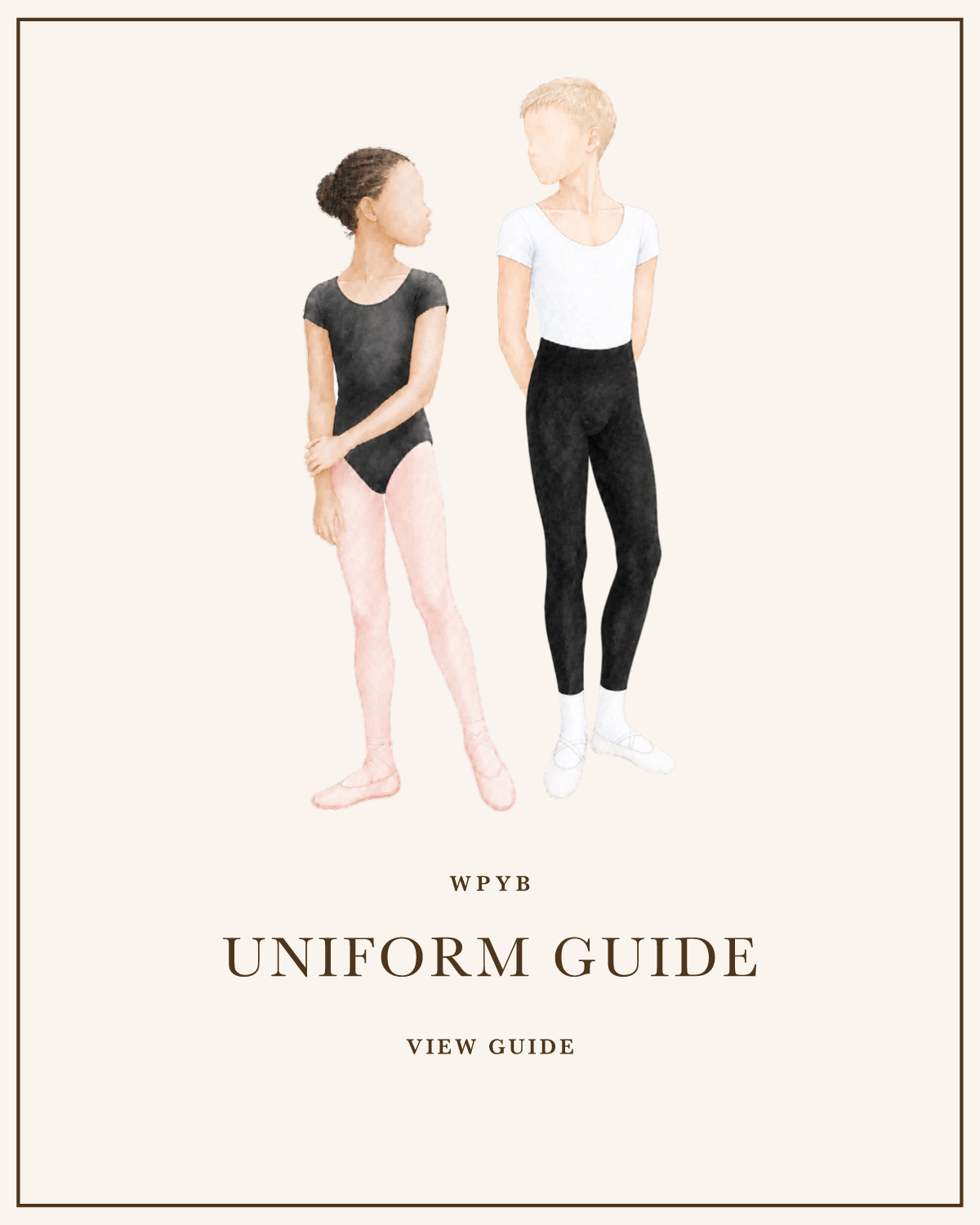
Each student wears the complete uniform assigned to their confirmed placement. The WPYB Approved Uniform Guide below identifies the exact required items for each program and level. Families should wait until placement has been confirmed before purchasing dancewear and should consult the guide before ordering. Color or general appearance alone does not make an item part of the approved uniform.
WPYB’s uniform progression reflects technical purpose and earned privilege. In Pre-Primary and the Primary Division, girls progress through a series of assigned colored leotards with attached skirts; boys follow the corresponding uniform identified in the guide. The changing colors mark advancement, while the attached skirts support imagination and introduce patterns of arm placement and presentation.
For girls in the Leveled Division, the uniform changes to a black leotard and black ballet slippers, signaling greater technical concentration and allowing faculty to see the direction of the heel and placement of the leg against pink tights. Later changes—including the return to pink slippers, the addition of ribbons in preparation for pointe, and other uniform privileges—mark increasing readiness and responsibility. The approved uniform for boys at each stage is detailed in the guide.
Hair
Hair must be neat, secure, and completely away from the face; when length permits, it must also be off the neck. Beginning in Pre-Primary, girls whose hair is long enough must wear a secure classical bun. Braids, locs, twists, extensions, and textured hair may be arranged in a bun or another secure style meeting the same standard. Short hair and boys’ hair must be neatly combed or secured away from the face and neck.
Small, secure bows, flowers, decorative clips, or beads are permitted when proportionate and when they do not interfere with movement, corrections, or the faculty’s view.
Students must arrive with hair fully prepared. Parents or caregivers are responsible for younger students and should practice the hairstyle before the first class. The WPYB Hair Guide below provides a bun tutorial, guidance for different hair lengths and textures, and examples of appropriate accessories.
Arrival, Changing & Footwear
Pre-Primary and Primary students must arrive fully dressed; changing in the hallway is not permitted. Leveled students may use the studio restroom but are encouraged to arrive dressed because the School has one restroom and limited changing space. All students must be completely ready when class begins.
To protect students’ privacy and safety, ballet attire must be covered when entering and leaving the building. Students should wear appropriate street clothing or warm-up layers over their dancewear—such as a coat, jacket, warm-up pants, skirt, or shorts—while in the parking areas and the building’s shared spaces. Outer layers may be removed upon arrival in the School’s designated student area and must be put back on before leaving.
Only the assigned uniform may be worn during class. Coats, sweaters, street clothing, leg warmers, separate skirts, and other additional garments must be removed.
Street shoes are removed in the designated hallway area and never worn or placed on the dance floor. Pre-Primary and Primary students use the provided cubbies. Leveled students may leave shoes, coats, and dance bags in the designated hallway area or place them in the assigned student area inside the School. Dance bags and other personal belongings may not be stored inside the classrooms.
Ballet slippers are for indoor class and rehearsal use only. All shoes, dancewear, dance bags, and other belongings should be labeled with the student’s name. Families are responsible for personal property; WPYB is not responsible for items that are lost, stolen, or damaged.
Before Purchasing Dancewear
Before purchasing any dancewear, shoes, or hair accessories, please review the WPYB Approved Uniform Guide and Hair Guide below.

Section 5: Studio Conduct & Ballet Etiquette
Ballet class depends upon more than physical effort. It requires an environment in which instruction can be heard, corrections can be understood, and every student can work without unnecessary distraction.
Young students are not expected to arrive already knowing the traditions and expectations of a ballet classroom. It is the responsibility of WPYB faculty to teach these habits clearly and consistently as part of each student’s education. Respect within the studio runs in both directions: students will be taught and corrected directly but respectfully, and they are expected to respond with the same respect.
Before technical instruction can be effective, faculty must provide a safe environment. The four expectations that follow are not rules or traditions for their own sake. They exist to protect students, preserve a productive working environment, and help each student develop responsibility for the space the School community shares.
1. Enter Ready to Work
Pre-Primary and Primary students enter and leave the studio together as a class under the supervision of their teacher. They do not enter the classroom independently. Personal belongings remain in the designated hallway area.
Leveled students may enter independently, organize their belongings, prepare for class, and wait in the assigned studio area. Students may talk and enjoy one another’s company while preparing, but they may not distract a class already in progress. Running, shouting, and disruptive play are not permitted.
Water bottles are not permitted inside the classrooms and must remain in the designated student area. Students may get a drink at an appropriate break, ordinarily between barre and center work. Snacks, meals, and other food must remain inside the student’s dance bag or in the designated food-storage area. Food, candy, gum, and open drinks are not permitted inside the classrooms.
A Technology-Free Learning Environment
WPYB is a technology-free learning environment for students. Phones, smartwatches, and other personal electronic devices must be silenced and stored inside the student’s dance bag upon arrival. They may not be used anywhere in the School during class or rehearsal hours without faculty permission.
Students do not need immediate access to a personal device while they are under the care of WPYB faculty. Ballet remains one of the few disciplines passed directly from one generation to the next through human instruction. WPYB deliberately protects this time so that each student’s attention remains with the teacher, the music, the movement, and the other people in the room.
2. Protect the Concentration of the Room
Once class begins, students should give their attention to the instruction and the work being presented. Side conversations, calling out, and disruptive behavior interfere not only with the individual student’s training but with the work of the entire class. If clarification is needed, a student may ask at an appropriate moment. Students should not shout out, interrupt, or speak while a faculty member is explaining or demonstrating.
Students may use the restroom when needed. They should let the teacher know before leaving whenever possible and return promptly, rejoining the class without unnecessary delay.
3. Receive and Apply Corrections
At WPYB, the responsibility of the faculty is not merely to give class but to teach the students in it. Corrections are one of the primary ways that individual teaching occurs.
A correction is not a punishment or an indication that a student has failed. It is evidence that the teacher is paying close attention and investing in the student’s progress. Students are expected to listen carefully, make an honest attempt to apply the correction, and continue working with it throughout the class.
Corrections given to one student often contain information that can benefit everyone. All students should remain attentive and consider how the instruction applies to their own work.
4. Respect the People and the Place
Students must treat faculty, staff, and classmates with courtesy and respect. Teasing, picking at, embarrassing, excluding, or deliberately interfering with another student is not permitted and will be addressed immediately.
At WPYB, the studio belongs to the students as much as it belongs to the faculty and the School. It is not simply the place where students take class; it is their ballet school—the place where they dance, work, and grow. Students should develop a genuine sense of ownership in the studio and understand that caring for it is part of belonging to it.
That shared ownership carries shared responsibility. Students and faculty work together to care for the space. Students should organize their belongings, pick up after themselves, help tidy anything that has been left behind, and leave the studio ready for the class that follows.
Barres, mirrors, sound equipment, and other studio furnishings are teaching tools. Students may not climb on, hang from, play with, or adjust them without permission.
Faculty will teach and reinforce these expectations in real time. Most concerns can be corrected through clear direction. If a student’s behavior creates a safety risk or prevents effective instruction, the student may be asked to observe until ready to rejoin the class. Repeated concerns will be discussed with the student’s family.
Section 6: Health, Safety & Student Well-Being
Ballet places meaningful demands on growing bodies and minds. Discipline never means ignoring pain, illness, or distress. Faculty will take concerns seriously and make immediate classroom decisions with safety as the priority. Faculty do not diagnose medical conditions; professional evaluation belongs to families and qualified healthcare providers.
1. Health Information & Illness
Families must keep health information and emergency contacts current in the Parent Portal and disclose any allergy, condition, injury, medication, accommodation, or circumstance affecting safe participation. Information will be shared only with those who need it to protect the student.
Students with fever, vomiting, symptoms of a contagious illness, or any condition preventing safe participation must remain home. A student who becomes ill while at WPYB should tell a faculty member immediately; participation may be stopped and the family contacted for prompt pickup.
Medication needed while a student is at WPYB must be disclosed and arranged in advance. Emergency medication, including inhalers and epinephrine auto-injectors, must remain immediately accessible under an agreed plan.
2. Toileting Independence & Restroom Assistance
Students entering Pre-Primary must be independently toilet trained unless an accommodation has been arranged in advance. Before attending, a parent or legal guardian must complete the WPYB Restroom Independence & Limited Assistance Acknowledgment and Consent through the Parent Portal.
Young students must recognize and communicate the need for the restroom, use the toilet independently, manage basic hygiene, and handle their leotard and tights. Families should practice the full process at home before the first class.
Students may use the restroom whenever needed. Faculty will encourage independence and may provide verbal guidance. When necessary, a member of the School faculty or another adult specifically authorized by WPYB, with all required clearances and the family’s signed consent, may provide the minimum assistance needed to pull up or readjust dancewear under the School’s safeguarding procedures.
WPYB does not provide routine toileting, wiping, diapering, or changing. If a student has an accident or needs care beyond limited assistance with dancewear, the family or emergency contact will be asked to respond promptly. Families must disclose any need that may affect restroom independence so an individual plan can be discussed before classes begin.
3. Pain, Injury & Return to Training
WPYB’s progressive syllabus is designed to develop strength, flexibility, coordination, and complexity in a safe sequence. Students are not rushed into material for which they are unprepared, and supplemental lower-level work may be assigned to reinforce safe foundations. Demanding training and safe training are not opposites; careful progression is what makes greater technical demands possible.
Students must report unusual pain, weakness, dizziness, or limitation rather than hiding it or working through it. Families must promptly report injuries occurring inside or outside the School and provide applicable medical restrictions.
Faculty may modify or stop participation or require observation when continuing would be unsafe. Written medical clearance may be required when an injury is significant or safe participation is uncertain. Return to full work may be gradual and will follow medical guidance and faculty assessment.
Active Class Observation
Beginning in Level 1A, students who can attend safely but cannot participate physically because of an injury or other noncontagious limitation are encouraged to observe. Students with a contagious illness must remain home.
Observers complete a WPYB Class Observation Sheet examining the material, corrections, and work they see, then submit it to the teacher. Technical ideas can be easier to recognize from outside a combination than while attempting it. Careful observation develops understanding and the ability to analyze and describe movement—skills valuable to dancers and future teachers. It is active participation, not punishment or embarrassment.
4. Hands-On Teaching & Physical Corrections
Classical ballet is taught through demonstration, language, imagery, and physical guidance. Purposeful repositioning can help a student connect verbal instruction with physical sensation, develop body awareness, and reproduce correct placement independently. This is especially valuable for young dancers still learning to understand their bodies in motion.
Appropriate hands-on correction is a standard and integral part of WPYB’s teaching. By enrolling, families understand that students will receive professional, age-appropriate physical guidance in the normal classroom environment. Students must report pain or any conflict with an injury or restriction, and families must inform WPYB of limitations affecting how a student may be positioned.
5. Pointe Readiness
Pointe is a meaningful privilege earned through preparation, and WPYB celebrates the achievement when a student is invited to begin. It does not start automatically at a particular age, level, or length of study. Faculty consider strength and control of the feet, ankles, legs, and torso; placement and turnout; technical understanding; maturity; consistency in applying corrections; attendance; concentration; and participation in every required class.
Students in the same level may be approved at different times because bodies develop differently. This is not a judgment of talent or potential. Students may not purchase, wear, or practice in pointe shoes without prior WPYB approval. Once approved, pointe is introduced only under faculty supervision through assigned exercises.
6. Student Protection & Emergency Response
Students are entitled to learn in a space where adults act professionally, appropriate boundaries are maintained, and concerns are taken seriously. Faculty, staff, contractors, and volunteers working directly with students must maintain the background checks and child-abuse clearances required by Pennsylvania law. WPYB will comply with mandated-reporting duties, including prompt reports to Pennsylvania ChildLine when there is reasonable cause to suspect abuse or neglect.
Students and families should promptly tell the School Director when something feels unsafe, uncomfortable, or worrying. No student will be punished or disadvantaged for raising a concern in good faith.
During a medical emergency or urgent safety situation, faculty may stop participation, move students, contact emergency services, and follow responding professionals’ directions. Students must follow instructions promptly. The family or emergency contact will be notified as soon as circumstances permit, but inability to reach them will not delay reasonable protective action.
Section 7: Family Partnership, Communication & Studio Access
A student’s education is supported by a partnership among the student, family, and School, but each has a distinct role. WPYB faculty teach ballet; families make that training possible through consistency, preparation, communication, encouragement, and trust in the classroom process.
1. The Parent’s Role in Training
Technical instruction belongs to WPYB faculty. Parents and caregivers should not coach, correct, stretch, condition, or direct ballet practice at home or ask students to repeat class exercises for family feedback. Incorrect practice can establish habits that interfere with the progressive syllabus.
WPYB does not assign regular classwork for home practice. As students mature, faculty may prescribe a specific stretch or strengthening exercise or ask them to review choreography. Students should perform only the work assigned and exactly as instructed; families may encourage it but should not coach, add repetitions, or increase its difficulty.
Children should always feel free to dance and create at home. The distinction is between spontaneous movement and an adult-directed ballet lesson. Families provide their best support by protecting attendance, preparation, rest, and nutrition; encouraging effort without pressure; and allowing home to remain a place of support rather than a second classroom.
The Full Program is designed to provide a complete and coherent course of ballet training. Families of Full Program students must receive prior WPYB approval before adding outside ballet instruction, private coaching, or online technical training. When additional instruction, another discipline, or a different artistic perspective would benefit a student, WPYB will ordinarily provide, arrange, or specifically recommend that opportunity through the School. Outside training will be approved only when WPYB determines that it serves a clear purpose without conflicting with the student’s placement, workload, safety, or progress.
Outside training disclosed as part of an approved Open Program schedule will be considered through that student’s placement and enrollment plan.
2. Supporting the School Community
As WPYB grows, it can provide more classes, faculty, artistic perspectives, facilities, and performance opportunities. Families may help by volunteering when able, supporting School activities, recommending WPYB, and sharing its work. Contributions will differ according to each family’s circumstances; no single kind of support determines a family’s value.
3. Communication with the School
The Parent Portal and official School email are WPYB’s primary communication channels. Families must keep contact information current and regularly review schedules, announcements, forms, billing, and notices. Absences, late arrivals, injuries, health changes, and dismissal concerns should be reported as early as possible. Time-sensitive information should not be sent through social media or another family.
Questions about training, placement, progress, corrections, or classroom decisions should be directed to faculty or the School Director. WPYB discusses a student’s training, behavior, attendance, and placement only with that student and the appropriate family members.
Arrival and dismissal are not appropriate for extended family conferences. Families should request a private meeting or scheduled telephone call.
Student Self-Advocacy
Students are encouraged, at an age-appropriate level, to speak directly with teachers when something is confusing, uncomfortable, upsetting, or misunderstood. Raising a concern respectfully is not disrespectful. Faculty will listen, clarify, and make changes when appropriate; families can help students find the words for that conversation.
Learning to speak for oneself is part of becoming an independent student. With age-appropriate support, self-advocacy develops judgment, courage, confidence, and the ability to communicate respectfully—qualities that serve students in the studio and far beyond it.
Faculty will likewise address age-appropriate behavior or work habits directly with a student before involving the family. Families will be contacted when a concern is serious, affects safety or well-being, cannot be resolved directly, or requires their support. No child is expected to manage a serious concern alone.
4. Studio Access, Arrival & Dismissal
The studios are working classrooms where students must be free to concentrate, make mistakes, receive corrections, and develop an independent relationship with their teachers. WPYB has no parent waiting area, and hallways and student areas may not be used as one. Parents, caregivers, siblings, and guests may not remain in WPYB space during class or rehearsal.
For Pre-Primary and Primary, one adult may accompany the student to the designated drop-off area no more than ten minutes before class, help remove a coat and street shoes, and remain until the teacher collects the class. The adult must then leave promptly. Pickup begins no earlier than ten minutes before class ends, and students are released only to a parent, legal guardian, or other adult authorized in the Parent Portal. Faculty may request identification.
Leveled students may arrive earlier once the School is open and faculty are present. They may change, organize belongings, complete familiar warm-ups, and prepare without distracting another class. A parent may accompany a student to the studio door when needed but must then leave. Leveled students may leave independently only with written family authorization; otherwise, they remain inside until released to an authorized adult.
Families may wait elsewhere or visit public areas of the larger Aluminum City Arts building under its rules, but may not congregate in WPYB hallways or drop-off areas. They may not watch through doors or windows or photograph or record classes. Family participation will instead be welcomed through scheduled observations, performances, volunteer opportunities, and School events.
Drop-off and pickup must remain brief. Same-day dismissal changes must be sent through the Parent Portal or official School email and confirmed by WPYB; a student or another family cannot authorize a change.
When a young student needs help developing comfortable separation, faculty may direct a temporary gradual plan that works toward independent participation. Families must arrive promptly for dismissal and immediately report unavoidable delays. Students may not wait alone outside or leave to search for a caregiver. Updated documentation is required whenever a custody or release restriction changes.
Section 8: Performances, Rehearsals & Casting
The stage asks dancers to bring technical and artistic work into a shared, living moment. They must remember, adapt, trust their preparation, and remain connected to one another as the performance unfolds. That responsibility creates healthy pressure as well as the exhilaration of discovering what they can accomplish. Rehearsal and performance develop memory, musicality, spatial awareness, cooperation, adaptability, composure, courage, and earned confidence.
1. Class Training Comes First
Performance is an important part of a dancer’s education, but class is its foundation. WPYB will not replace scheduled technique classes with rehearsals or turn regular class time into preparation for an annual show; rehearsals are scheduled separately.
WPYB develops dancers over many years, not for a single presentation. Students must bring the same concentration, preparation, and openness to correction to rehearsal that they bring to class. Success is measured not by perfection or prominence but by preparation, commitment, composure, recovery, and generosity toward the ensemble.
2. Participation & Rehearsal Commitment
Unless otherwise stated, production participation is optional. Families will receive the known rehearsal and performance schedule before committing. Declining a production does not affect placement or standing in regular training.
Once a student accepts a production, all assigned rehearsals, technical and dress rehearsals, and performances are required, and known conflicts must be disclosed beforehand. Illnesses and emergencies should be reported promptly. If absences prevent reliable preparation, WPYB may adjust or reassign the role. Rehearsals never replace required classes.
3. Casting & Role Assignment
Casting belongs to WPYB’s artistic faculty and reflects the production’s needs and each student’s readiness, artistry, maturity, reliability, and rehearsal work.
There are no small roles. An assignment with choreography perceived as simpler or with less stage time can provide exceptional room for characterization, musicality, projection, and presence. Every role is an opportunity to learn, contribute, and shine.
When a student feels disappointed, families can acknowledge the feeling without treating the assignment as unimportant or suggesting the student deserved something else. A more valuable response is to help the dancer consider what the role offers, why it may have been assigned, and how to make the contribution exceptional.
Families and students may not request, negotiate, or compare roles. Casting may change when attendance, preparation, safety, or production needs require it.
4. The School’s Responsibility for Production
WPYB’s first responsibility is to build strong classes and train students consistently. Productions will be introduced when the students and School are prepared—not simply because an annual recital is expected. Their timing and scale depend upon student readiness, enrollment, faculty, venues, and financial resources. As the School grows, performance opportunities can grow with it.
WPYB’s goal is to offer performance opportunities without creating a separate financial burden for families. The School will make every reasonable effort to support production and costume costs through School resources and collective fundraising. If a future production requires a family contribution, the amount will be disclosed before the family commits to participate.
WPYB will develop its own repertoire, costumes, and production materials. Items provided by the School remain its property and must be fitted, used, cared for, and returned as instructed; they may not be altered without permission.
5. The Family’s Role in Productions
WPYB directs the artistic work, rehearsals, student preparation, and operation of its productions. Families support students in honoring commitments, arriving prepared, and following instructions.
Unless assigned a volunteer role, parents and caregivers attend as audience members. They do not attend rehearsals, enter student or production work areas, assist with costumes, or give performance directions unless requested. Volunteer assignments, schedules, procedures, and venue requirements will be communicated for each production.
Section 9: Enrollment & Financial Policies
WPYB reserves places, schedules classes, and plans faculty and facilities according to enrollment. The following policies explain the commitment and financial terms before registration.
1. Year-Round Enrollment & Tuition
WPYB operates a twelve-month training year from September through August. September begins the new training year and is the usual time for level changes, but enrollment remains open whenever appropriate placement and space are available. Students who begin after September are charged starting with their first month of training and are not charged for earlier months. WPYB does not charge a registration fee. The first monthly tuition installment is due at registration to reserve the student’s place and will be applied to the student’s first month of classes, even when registration occurs before the start date.
The Full Program and Open Program enrollment paths are described in Section 2. Current class-load requirements and rates will appear in the School’s schedule and registration materials.
Regular training continues in summer, although the schedule may be adjusted, condensed, or expanded. Planned closures and breaks are included in the annual calendar.
Tuition is established for the full training year and divided into twelve equal monthly installments. An installment is part of annual tuition—not the price of a particular month or number of classes—so it remains the same during months with holidays, closures, or different numbers of meetings.
Class sizes are limited so that students can receive appropriate instruction. WPYB will make every reasonable effort to find an appropriate place for each student. When a class is full, the School may offer another suitable class, place the student on a waiting list, or add a new section when enrollment, faculty, facilities, and scheduling permit. A new section cannot be guaranteed, and enrollment remains subject to appropriate placement and available space.
Continued enrollment reserves the student’s place. Enrollment cannot be paused while holding that place; withdrawal releases it, and reenrollment remains subject to space and faculty placement.
Optional camps, workshops, or special programs may carry an additional charge and will be identified before registration. Annual registration occurs through the Parent Portal, where current tuition, fees, schedules, and agreements will appear. A class request does not guarantee enrollment or override faculty placement.
2. Family Tuition Discount
WPYB recognizes the financial commitment involved when more than one child from a family trains at the School. Families with two or more children enrolled in Pre-Primary, Primary, or the Full Program of the Leveled Division are eligible for the Family Tuition Discount. Open Program enrollment does not qualify.
The student with the highest regular monthly tuition is charged at the full rate. Each additional qualifying student receives a ten-percent discount from their respective regular monthly tuition. The same discount applies to every additional qualifying student and does not increase according to the number of children enrolled.
The discount applies only while at least two qualifying students remain actively enrolled through the same family account. If enrollment changes, the discount will be recalculated beginning with the next unprocessed monthly installment.
The Family Tuition Discount applies only to regular tuition. It does not apply to private coaching, camps, workshops, special programs, or other non-tuition charges. It may not be combined with another tuition discount unless approved by the School.
3. Billing, Payments & Account Status
The first tuition installment is paid at registration. Subsequent monthly installments are posted to the Parent Portal before the month begins and processed automatically on the first day. Families must maintain a valid payment method and current billing information.
A student beginning after the billing cycle starts pays a prorated first installment for the remaining portion; full installments begin the following month.
Families will be notified of declined payments. Applicable late or returned-payment fees will be disclosed during registration. Participation may be suspended when an account remains unpaid and no arrangement has been approved. Families anticipating difficulty should contact the School Director before the due date when possible; an alternative arrangement may be approved at the School’s discretion.
Except during approved extended medical leave, tuition is not reduced for short-term illness, injury, absence, vacation, or a decision not to attend while enrolled. Missing class does not cancel enrollment.
4. Withdrawals, Medical Leave & Refunds
Ballet training naturally includes periods when a student may feel frustrated or less motivated. When circumstances permit, WPYB encourages families to consult faculty and allow approximately sixty days before withdrawing over a temporary difficulty. This is an educational recommendation, not a required notice period; the final decision belongs to the family.
A parent or legal guardian may withdraw a student at any time through the Parent Portal or official School email. Verbal notice and nonattendance do not cancel enrollment. Future tuition ends with the next unprocessed installment, and the student’s place is released.
A student who can safely continue through modified participation or Active Class Observation is not on medical leave. If a physician confirms that a student cannot participate meaningfully for one or more complete billing months but plans to return, the School Director may approve extended medical leave. Tuition pauses with the next full billing cycle, the student’s place is preserved, and updated medical documentation may be required before physical participation resumes. Shorter illnesses, injuries, and absences do not qualify.
Processed tuition is nonrefundable, and no prorated credit is issued for unused classes within a paid period. If WPYB permanently cancels a class without an appropriate alternative, it will provide a credit or refund for unused tuition.
Section 10: Community Standards & Media
WPYB protects student privacy and the integrity of School work. This section establishes the additional boundaries needed for photography, recording, and School-related media.
WPYB welcomes students and families of all backgrounds. Discrimination or harassment is not permitted. Placement and advancement are based on age, readiness, and educational needs.
1. Student Privacy & Recording
Information about a student’s training, placement, behavior, health, or family circumstances is private and will be discussed only with the student, appropriate family members, and faculty or staff who need it.
Students, families, and visitors may not photograph, film, livestream, or record classes, rehearsals, or instruction. Outside those settings, families may photograph or record their own student, but not another student without permission from that student’s parent or legal guardian. Recording is never permitted in restrooms or changing areas.
2. School Photography & Media Permission
WPYB may photograph or record School activities for educational, archival, and promotional use. A parent or legal guardian selects media permission during annual registration. Permission is optional and does not affect training or participation.
WPYB will select and present images respectfully, age-appropriately, and with the intention of showing students at their best as developing artists. The School will not publish a minor’s full name with an individual image or recording without specific permission.
When permission is declined, WPYB will make reasonable efforts not to use an identifiable image of that student in promotional materials. Families may change permission prospectively in writing. WPYB will discontinue future use and make reasonable efforts to remove material from School-controlled platforms, but previously printed, distributed, or externally published material may not be retrievable.
3. Social Media & Responsible Sharing
WPYB respects personal expression and does not monitor private social-media accounts. When online activity involves the School or community, students and families should use the same care expected in person. Digital material can be copied, redistributed, and remain accessible after deletion; a post made in frustration, humor, or without context may unintentionally harm the author, another person, or the School community.
Families may share authorized images of their own student. Permission should be obtained from another student’s parent or legal guardian before posting an image in which that student is identifiable. Private Parent Portal content, WPYB-provided rehearsal recordings, choreography, and limited-use educational materials may not be posted publicly without authorization.
Students are learning digital judgment. When appropriate, a mistake will first be treated as an opportunity to reflect and correct it. Family involvement or further action may be necessary when online conduct bullies, ridicules, threatens, impersonates, reveals private information, or materially affects safety, well-being, or training.
Nothing here prevents good-faith opinions or concerns. WPYB encourages School concerns to be raised directly through official channels. Only WPYB may use its name, logo, or identity for an account or publication suggesting official representation.
4. Representing the School Community
WPYB is a small community within a larger one. Students, families, and faculty represent one another, and the courtesy, responsibility, and respect practiced inside the studio should extend to how they treat people, property, shared spaces, and themselves elsewhere.
5. Continued Enrollment
WPYB will ordinarily work privately with a student and family to resolve concerns. If serious or repeated conduct by a student, parent, caregiver, or another connected person threatens safety or well-being, disrupts instruction or operations, or makes cooperation no longer possible, WPYB may suspend or end enrollment. Such decisions will be made carefully and only when necessary to protect the School community.
Section 11: Annual Acknowledgment & A Final Word
This handbook is detailed because families deserve to understand how WPYB operates and why its expectations exist. No one must memorize every sentence; current schedules, announcements, forms, and account information remain available through the Parent Portal.
1. One Annual Registration Process
Before each training year, WPYB will provide one coordinated registration process through the Parent Portal. Required selections and acknowledgments will be completed together in one place.
A parent or legal guardian will review or update contact, emergency, health, and authorized pickup information; confirm schedule and tuition; maintain the required payment method; make the media-permission selection; and complete the handbook acknowledgment and other authorizations.
Enrollment is confirmed when registration is complete and the first tuition installment has been paid. Families will be notified of material policy changes during the year and may be asked to acknowledge them through the Parent Portal.
2. Family Acknowledgment
By completing annual registration, a parent or legal guardian acknowledges access to this handbook, an opportunity to ask questions, and an understanding that its policies govern enrollment. The family agrees to keep required information current and support the student in following applicable expectations.
Families should review relevant portions with students at an age-appropriate level. Faculty will teach classroom expectations directly; young students are not expected to interpret the handbook independently.
3. A Final Word
Read from beginning to end, this handbook may seem like many rules. In daily life, most quickly become simple habits: arrive prepared, listen, work honestly, care for the people and places around you, and communicate when something is wrong. Once those habits are established, the rules recede and the training comes forward.
WPYB takes ballet and its responsibility to students seriously, but every moment need not feel solemn. Students should work hard, make mistakes, laugh, recover, try again, and experience the pleasure of dancing together. Clear boundaries create the safety and trust that allow that to happen.
Everything here serves the same purpose: to protect students, support their education, and build a School where discipline, kindness, excitement, and joy can coexist. Ballet brings us into the room; the larger work is helping young people become capable, courteous, resilient adults who carry what they learn far beyond the studio.